
by Marcelo Fernandez
Author of the Agent Control Protocol (ACP) — the admission control infrastructure for autonomous agents operating in institutional environments. TraslaIA is where that architecture meets production.
Autonomous agent systems architect · ACP Author · Founder of TraslaIA

I'm Marcelo Fernandez, an AI and intelligent automation consultant with 15+ years of experience in strategic leadership and digital transformation. Founder of TraslaIA, where I design and implement the infrastructure connecting AI systems to real-world operations.
I'm the author of the Agent Control Protocol (ACP), the open governance standard for autonomous agents published on Zenodo and arXiv. ACP defines who authorized an agent, what it executed, and who is accountable for the outcome — cryptographically verifiable, across systems and institutions.
My work spans from multi-agent system architecture to operational workflow implementation with n8n, generative AI, OCR, and vector databases. I've worked with over a dozen organizations achieving up to 80% reduction in manual process time.
Governance infrastructure for autonomous agents.
ACP defines who authorized an agent, what it executed, and who is accountable for each outcome — cryptographically verifiable, across systems and institutions. It operates as an admission control layer on top of existing RBAC and Zero Trust, without replacing them.
Cryptographic proof chain of who authorized each agent action. Ed25519 signatures bind every operation to an authenticated human or institution.
Scoped capability-based access: an agent only holds the permissions explicitly granted. No implicit inheritance, no privilege escalation.
Deterministic, auditable mapping from action to the exact policy rule that permitted it. No ambiguity — every execution leaves a verifiable policy trace.
Independent third-party auditability of every operation. Immutable audit logs enable compliance, post-incident analysis, and institutional accountability.
From governance design to operational deployment — built on the principles behind ACP
Design of permission models, delegation chains, and audit trails for autonomous agent systems. Based on ACP. Whether you're deploying your first agent or governing a fleet — we design the institutional control layer.
Deploy the Agent Control Protocol in your infrastructure. From L1 identity anchoring to full L4 multi-institutional delegation. Includes Go reference implementation and conformance test suite validation.
Design and implementation of intelligent multi-agent workflows with n8n. Memory management, tool routing, and contextual execution for complex agent pipelines.
Design and deployment of scalable n8n workflows that convert manual operations into structured, observable, and maintainable automation layers.
Connect disparate systems via REST APIs, webhooks, and cloud services to build efficient and observable digital ecosystems.
Intelligent data extraction from invoices and documents with adaptive OCR, structural validation, and traceable output pipelines.
Real workflows built with n8n solving complex problems
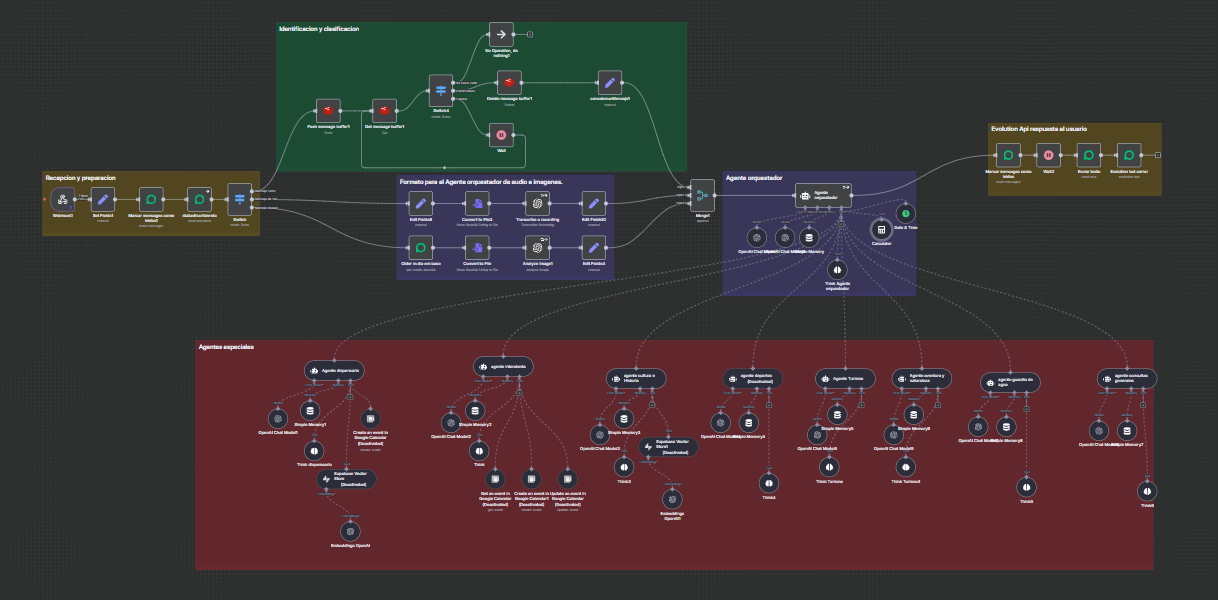
Multi-agent architecture with audio and image processing, contextual memory, and specialized action execution coordinated by a central orchestrator.
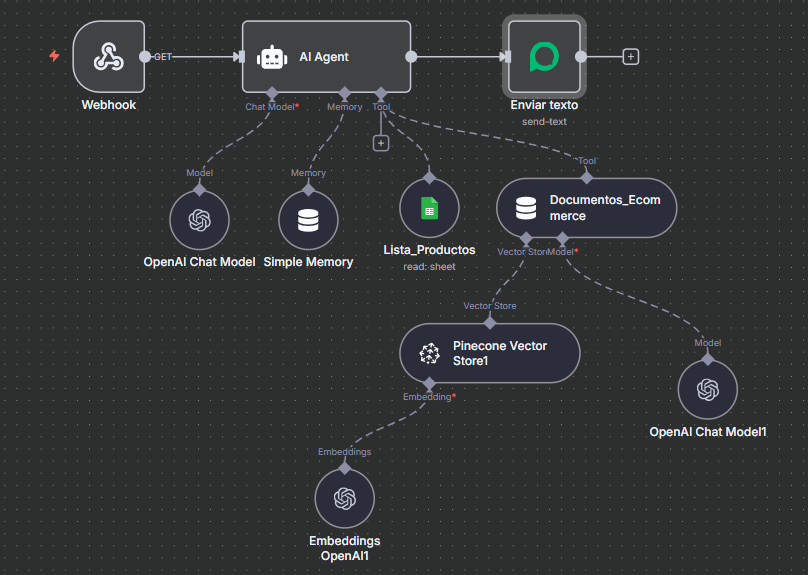
RAG pipeline with Pinecone vector search, OpenAI embeddings, conversational memory, and product catalog query from Google Sheets.
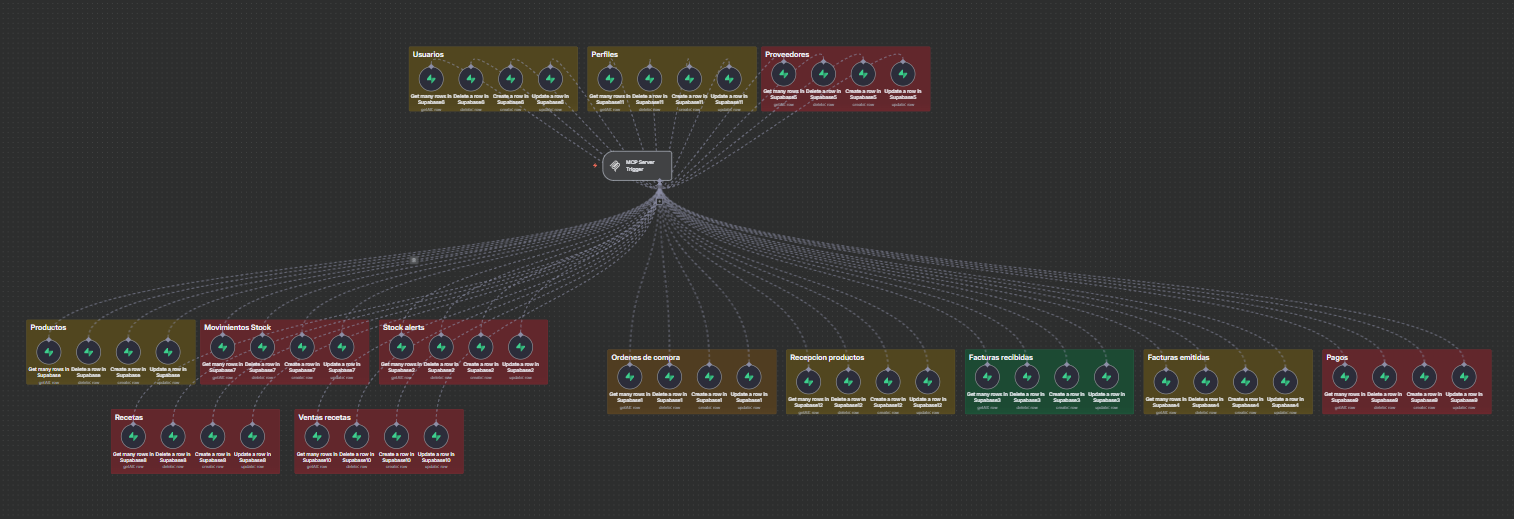
MCP server orchestrating 14 business entities over Supabase: users, products, stock, orders, invoices, and payments. Tool architecture for LLM agents.
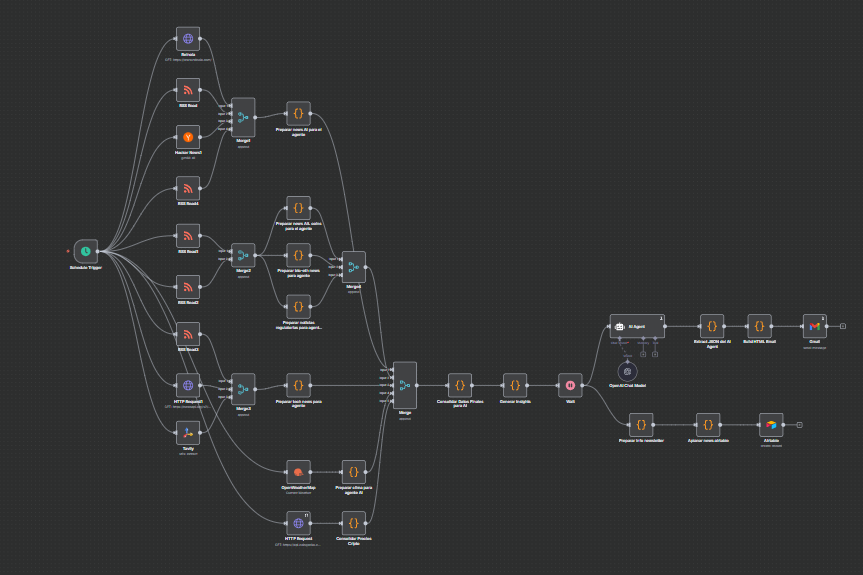
Multi-source RSS ingestion, semantic classification with AI, Airtable persistence, and automatic newsletter generation.
Systems built to run in production.
Foundation for any system delegating actions to agents with real accountability.
Foundation for intelligent SaaS with verifiable task delegation.
Scalable document processing with effective reduction of human errors.
Structured digitization of internal operations for SMBs.
Active tools, technologies, and accreditations
Are you deploying autonomous agents, need governance infrastructure, or want to implement ACP in your organization? Let's talk.
